
Telangana’s Future City: A New Chapter in Urban Development
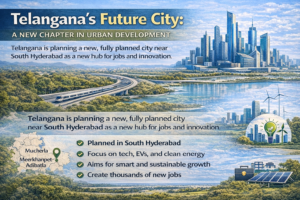
Telangana Future City Telangana is planning one of its most ambitious urban projects yet — a brand-new, fully planned city near South Hyderabad. Known as Future City, this project is designed to support long-term economic growth, create employment opportunities, and reduce pressure on existing parts of Hyderabad Telangana Future City
Telangana Future City As Hyderabad continues to expand rapidly, the state government believes that simply extending current infrastructure is not enough. Instead, it wants to build a modern city from the ground up — one that is designed for the needs of the next 25 years and beyond Telangana Future City
Why Telangana Needs a Future City
Over the past decade, Hyderabad has become one of India’s fastest-growing metropolitan areas. The IT sector, pharmaceutical industries, startups, and global companies have all contributed to this growth. However, rapid expansion has also led to challenges such as traffic congestion, rising real estate prices, infrastructure strain, and uneven urban planning.
Most major IT and business hubs are concentrated in western Hyderabad, including areas like Gachibowli, HITEC City, and Financial District. This has created imbalance in development across the city.
Future City aims to address these issues by creating a new growth corridor in South Hyderabad. Instead of overloading existing areas, the state plans to distribute development more evenly Telangana Future City
Planned Location
Future City is expected to come up in South Hyderabad, around areas such as Mucherla, Meerkhanpet, and Adibatla. These locations are strategically chosen because they are close to the Outer Ring Road and Rajiv Gandhi International Airport, making connectivity easier.
The idea is to build a large, integrated urban zone with proper road networks, transport systems, industrial clusters, and residential neighborhoods — all developed in a structured and phased manner.
What Will Future City Include?
Future City is not just another residential project. It is envisioned as a multi-purpose urban ecosystem. The plan includes:
-
Business and commercial districts
-
Industrial parks
-
Technology and innovation hubs
-
Residential communities
-
Educational and research institutions
-
Healthcare facilities
-
Green spaces and recreational zones
The goal is to create a self-sustained city where people can live, work, and access essential services without long commutes.
Focus on Technology and Advanced Industries
One of the main highlights of Future City is its focus on high-growth sectors. Telangana wants to attract industries that represent the future of global business.
The city is expected to focus on:
-
Information Technology (IT)
-
Artificial Intelligence (AI)
-
Data Centers
-
Semiconductor manufacturing
-
Electronics production
-
Electric Vehicles (EV)
-
Aerospace and defense manufacturing
-
Renewable energy and green technologies
By targeting these industries, the government hopes to position Telangana as a leading hub for advanced manufacturing and innovation in India.
Sustainability and Smart Planning
Unlike older parts of many Indian cities that grew without proper long-term planning, Future City is designed to prioritize sustainability from the beginning.
The proposed city is expected to include:
-
Wide roads and planned transport systems
-
Public transport integration
-
Green belts and parks
-
Renewable energy usage
-
Efficient water management systems
-
Smart infrastructure and digital connectivity
This approach aims to create a cleaner, greener, and more organized urban space.
Economic Impact
Future City has the potential to significantly boost Telangana’s economy. Large-scale infrastructure projects usually attract both domestic and international investors. With the right policies and incentives, the new city could become a magnet for global companies.
The economic benefits may include:
-
Thousands of new jobs across sectors
-
Growth in real estate and construction
-
Increased foreign direct investment (FDI)
-
Expansion of small and medium enterprises
-
Higher state revenues
In addition, the project may also stimulate development in surrounding districts, creating ripple effects beyond Hyderabad.
Real Estate and Infrastructure Growth
Large urban projects often transform nearby land markets. As infrastructure develops, property values in surrounding areas may rise. This can attract developers, commercial investors, and residential buyers.
However, the government’s focus is not just on real estate growth but on balanced urban planning. By designing the city in phases, authorities aim to avoid unplanned sprawl.
Challenges Ahead
While the vision for Future City is ambitious, large-scale projects come with challenges. Land acquisition, environmental clearances, funding, and execution timelines are key factors that will determine the success of the project.
Additionally, ensuring affordable housing and inclusive growth will be important so that development benefits multiple sections of society, not just corporations.
Proper governance, transparency, and long-term commitment will play a crucial role in turning the vision into reality.
Long-Term Vision: 2047 and Beyond
Future City is part of Telangana’s broader long-term development vision that looks ahead to 2047, marking 100 years of India’s independence. The idea is to prepare the state for future economic shifts and technological transformations.
By investing in infrastructure, technology, and sustainability today, Telangana hopes to secure its position as a global investment destination in the coming decades.
Conclusion
Telangana’s Future City represents a bold step toward planned urban growth. Instead of allowing expansion to happen naturally and unevenly, the state government is choosing to design a new city that aligns with future economic trends and sustainability goals.
If implemented successfully, Future City could reduce pressure on existing urban areas, create thousands of jobs, attract international investment, and transform South Hyderabad into a major economic corridor.
In simple terms, Future City is Telangana’s roadmap for building a smart, modern, and future-ready urban center — one that aims to shape the state’s growth story for decades to come.